


The emergence and development of advanced digital technologies are significantly changing lawyers’ work. An audio or video recording can now be fabricated in minutes, requiring legal professionals to reassess prosecution evidence in a new way.
Voice synthesis — a new challenge for lawyers
A recording may contain a voice resembling that of a suspect even though the person never uttered the recorded words. It is critically important to verify the origin of a recording that the prosecution seeks to use as proof of guilt. To make a substantiated allegation of fabrication, the defence must identify precisely which details raise doubts and properly prepare the materials for expert examination.
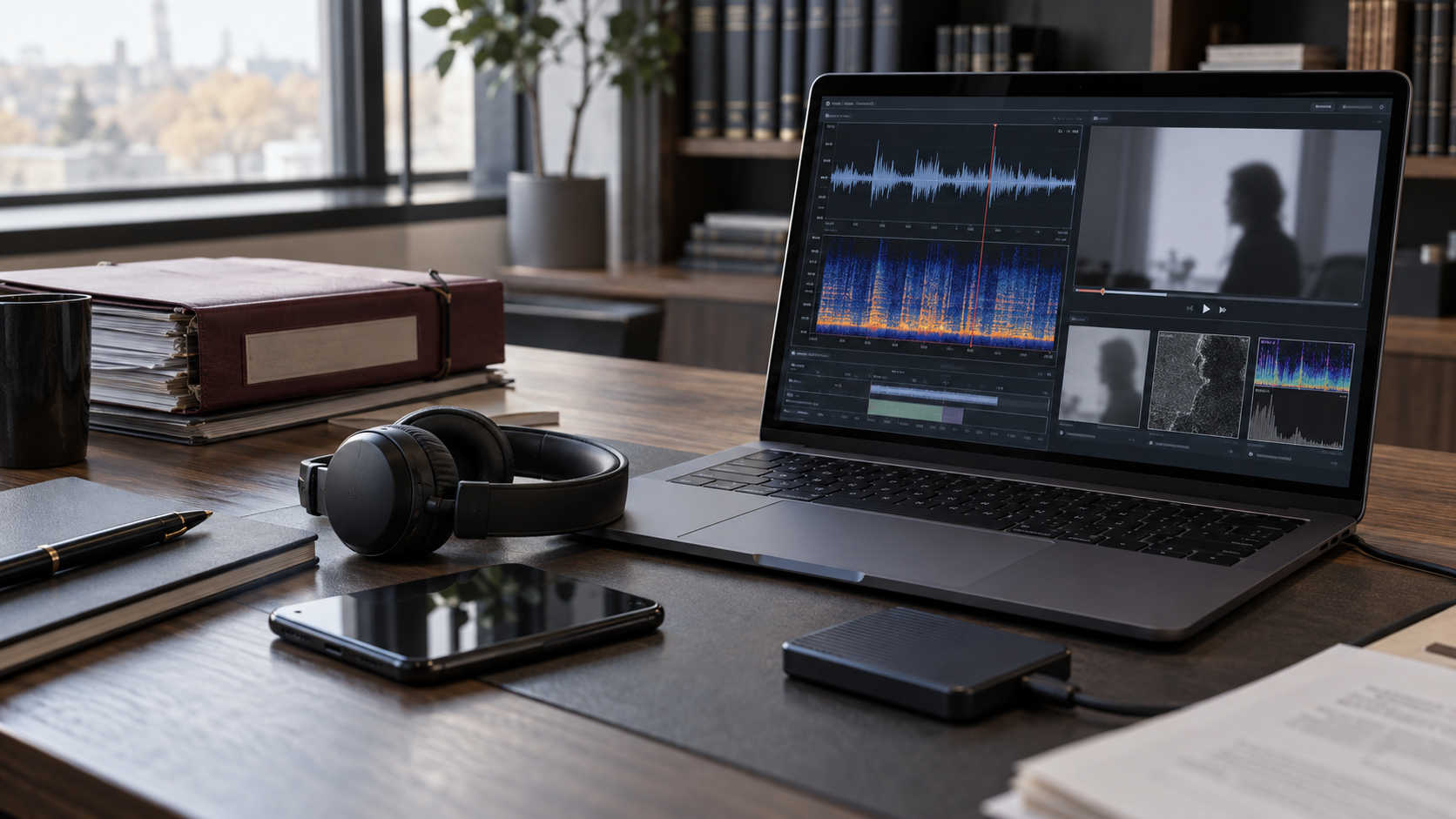
Synthetic recordings include audio and video materials created entirely or materially altered using artificial intelligence. During an examination, experts analyse the digital file itself for traces of generation or editing. The defence must distinguish between identifying a person by voice or image and determining whether the file reflects the alleged event. Even a voice that perfectly resembles the suspect’s does not prove that the recording is authentic. If there is any doubt or reasonable basis for concern, the possibility that the recording was generated must be investigated.
A practical case analysis
Consider an example. The prosecution submits an audio recording in which a person allegedly agrees to accept an improper benefit. The defendant denies that the conversation ever took place. The file’s origin is unknown, while the expert examination confirmed only that the recorded voice resembles the suspect’s. In these circumstances, defence counsel should immediately establish whether the experts tested the recording for AI generation and whether the file quality allowed such testing. This example makes the issue clear: unless the lawyer asks the experts the right questions, a key fabrication hypothesis will remain unexamined.
Article 94 of the Criminal Procedure Code of Ukraine provides the legal basis for this assessment: it distinguishes relevance, admissibility and credibility of evidence and gives no item of evidence predetermined weight. If there is doubt as to whether a conversation actually occurred, that is specifically a question of the recording’s credibility. The mere use of artificial intelligence does not itself determine a file’s evidentiary value. In a fraud case, for example, an AI-generated voice may instead be the principal evidence of how offenders deceived the victim. See also our article on social engineering against lawyers.
Specific features of examining digital recordings
Preparation for an examination should begin by establishing the recording’s source and chain of custody. A lawyer needs to determine who created or received the file, which device it was obtained from, to whom it was transferred and whether the complete recording has been preserved. Digital-evidence guidance generally frames verification in three stages: where the audio originated, whether it was altered and how the file was transferred. Every expert conclusion must be clearly supported by technical analysis. Although such guidance provides a useful reference point, it is not a legal basis for assessing evidence under Ukrainian law.
For expert examination, it is advisable to obtain the file in its earliest available form, information about the device and recording method, and records of its seizure and copying. The technical need to examine the earliest available version should be distinguished from the procedural status of an original document. Article 99 of the Criminal Procedure Code of Ukraine specifies circumstances in which copies of information may be recognised as an original document. The mere fact that a copy was submitted therefore does not resolve the question of its admissibility or credibility.
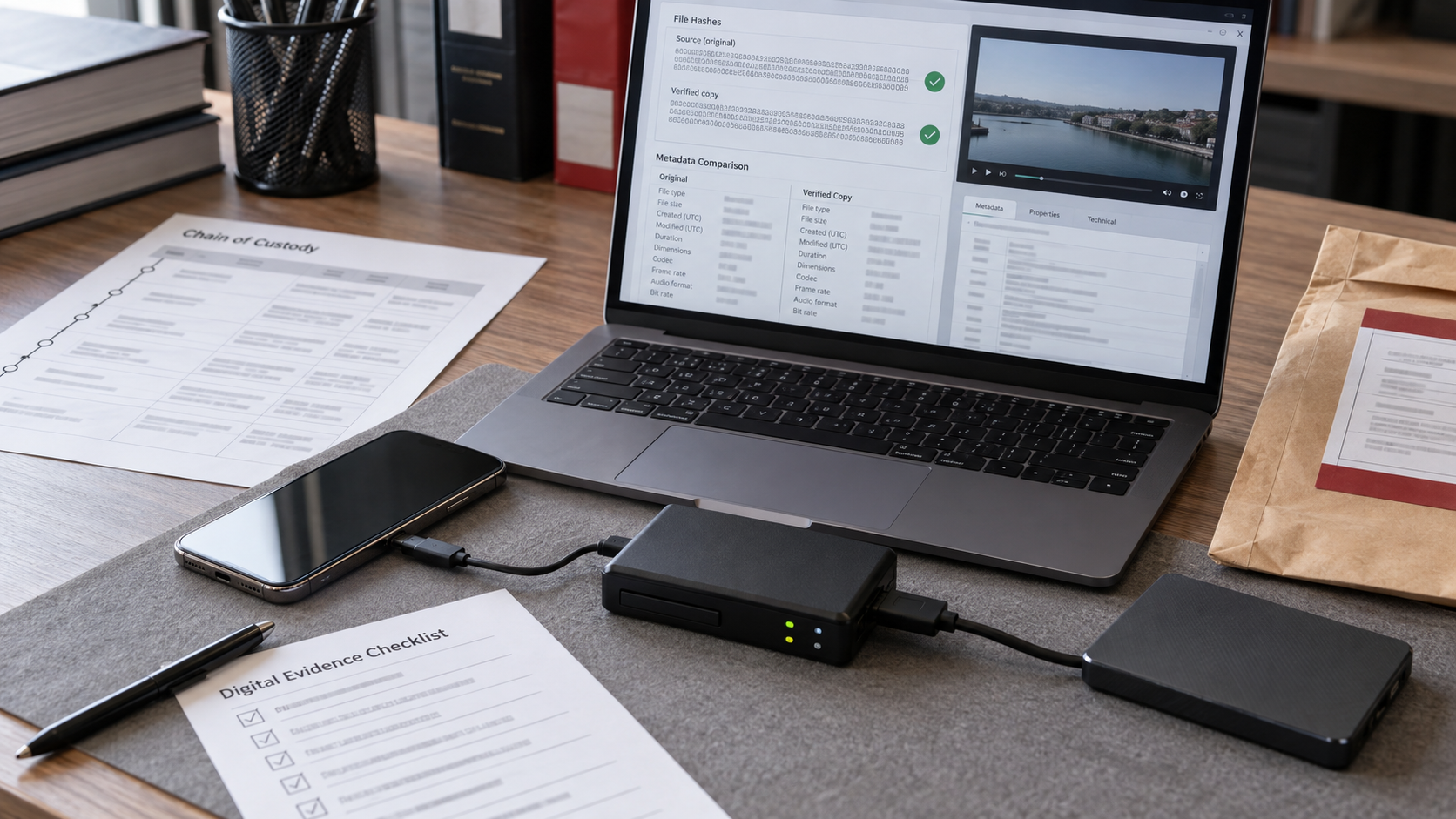
An examination should pay particular attention to metadata — service information about the file — and its verification hash values. Metadata can be altered and must therefore be assessed together with other properties of the recording. Matching properly calculated cryptographic hashes can establish that the files being compared are identical. A checksum recorded after seizure, however, does not guarantee that the content is truthful or that no changes occurred before that point. Lawyers must understand these technical limitations to protect their clients and challenge prosecution arguments.
Questions for the expert should be formulated clearly, taking account of the expert’s experience, the recording quality and available technical capabilities. An indicative list may include:
- whether the specified file or any of its fragments shows signs of AI-based speech synthesis or alteration;
- whether there are signs of editing, replacement or insertion of fragments;
- whether the file’s technical characteristics correspond to the stated method of creation;
- whether the video shows signs of alteration to a person’s image or to the relationship between sound and image.
Each question should identify the relevant file and, where necessary, the time interval.
It is also advisable to establish which limitations arise from the recording’s duration, compression or absence of source materials. The proposed list must be adapted to the particular case and does not imply a universal method for detecting generation. The expert’s task is to establish technical circumstances within the scope of specialised knowledge. Questions concerning admissibility or a person’s guilt fall outside that scope; Article 242 of the Criminal Procedure Code of Ukraine prohibits expert examinations on questions of law.
Factors affecting the performance of digital detectors
A report by the US National Institute of Standards and Technology states that the effectiveness of synthetic-audio detection depends on the method, test data and processing applied to the recording. Performance may be reduced by generation methods unknown to the detector and by background noise. A model developed for English may also perform substantially worse when detecting synthetic audio in other languages. This leads to a practical recommendation for Ukrainian lawyers: always verify whether the tool used was evaluated for Ukrainian speech and for the conditions of the particular recording.
A detector’s numerical score requires explanation: what exactly it measures, which threshold produced the result and which error rates were established during testing. Defence counsel should obtain the software name and version, a description of file preparation, analysis parameters and the basis for the interpretation. This information must be assessed alongside the results of other examinations. Running several services without examining their methods does not provide independent confirmation.
The statement “no signs of generation were detected” in an expert opinion does not mean that a recording is one hundred per cent authentic. It means only that the expert’s particular methods did not detect evidence of fabrication in the submitted file. Extending that conclusion to every possible method of creating the file requires separate justification. Audio-authentication guidance recognises the possibility of an inconclusive result and cautions experts against expressing excessively categorical conclusions.
The defence’s procedural options include retaining an expert independently under Article 243 of the Criminal Procedure Code of Ukraine and applying to an investigating judge where the grounds in Article 244 are met. Article 102 requires a description of the examinations performed, the methods applied and reasoned answers. During trial, Article 356 allows questions to be put to the expert about methodology, the sufficiency of materials and the scientific basis of the opinion. Objections should therefore be tied to a specific deficiency: unverified file provenance, an unsuitable method or a conclusion extending beyond the results obtained. See also our article on protecting lawyer–client confidentiality.
Why joint guidance for lawyers and experts matters
To make this work easier and more effective, lawyers and forensic experts should jointly develop consistent guidance for preparing materials and formulating questions in cases involving suspected synthetic recordings. Such guidance should specify the information needed to verify file provenance, requirements for documenting the tools used and ways to present the examination’s limitations. It is especially important that another expert be able to verify and reproduce the results.
This approach supports a focused examination without presuming that every digital item is fabricated. The general ability to generate media does not prove that a particular file was falsified, while convincing sound or imagery does not eliminate questions about its origin. The lawyer’s task is to identify circumstances affecting the recording’s evidentiary value and ensure that they are properly examined. Active defence work does not alter the obligation under Article 17 of the Criminal Procedure Code of Ukraine to prove guilt beyond a reasonable doubt.
Expert analysis and legal representation share a common objective: to ensure an objective examination of the circumstances, not merely to allege fabrication. Only a properly verified recording can therefore provide a lawful basis for a judicial decision.
Digital audio and video examination
Do you suspect a synthetic recording or need to prepare questions for an expert examination?
Contact ProDefence — we will help assess the file’s provenance, prepare materials for examination and formulate technical questions without making unsupported guarantees about the expert result or procedural decision.
Confidential. We will never ask for a seed phrase or private keys.


