


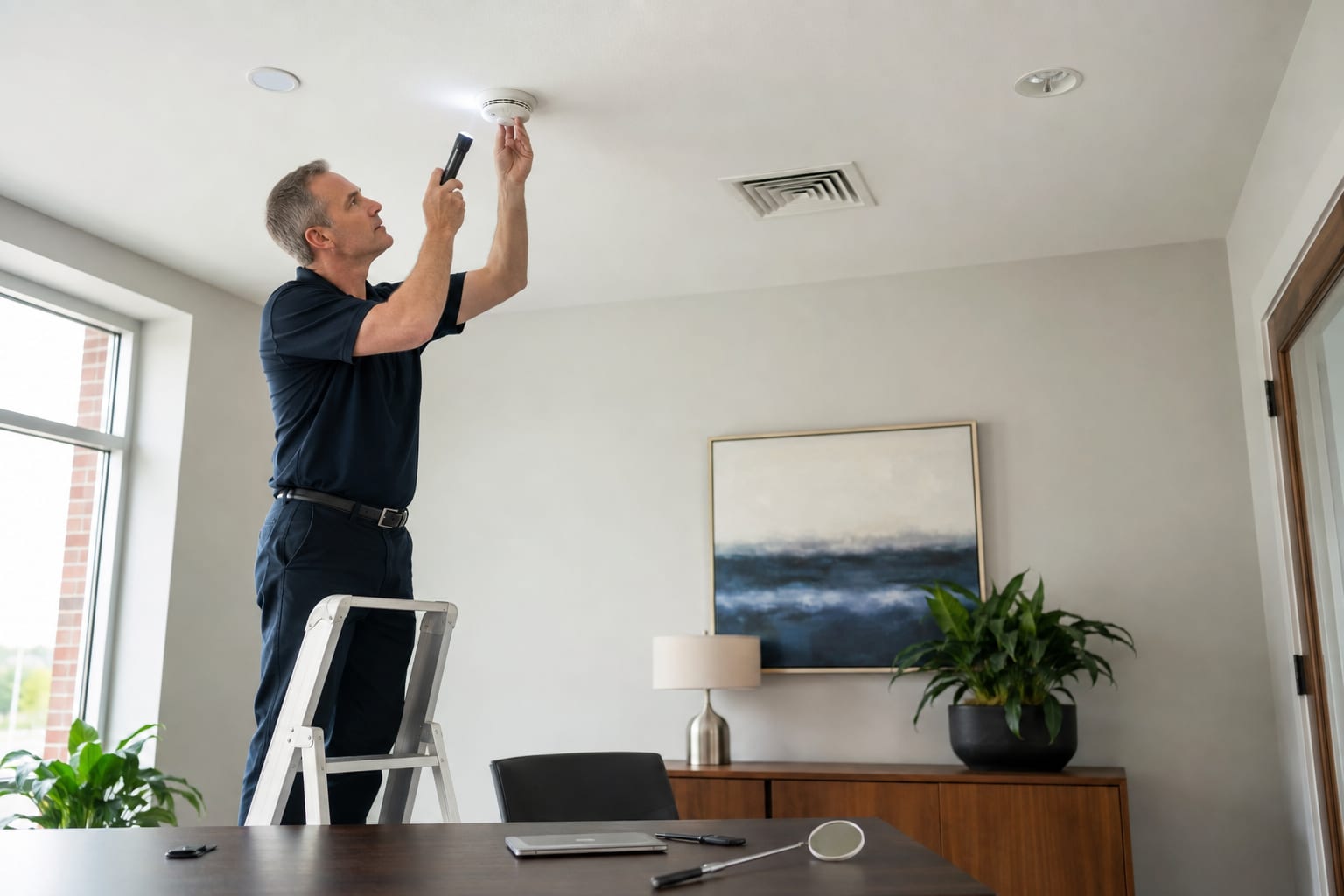
A conversation can leak without a bug inside the room. Voice creates air vibrations that pass through gaps, doors, and ventilation ducts, and also cause walls, pipes, and glass to vibrate. Under favourable conditions, part of the speech can be heard or technically recorded from an adjacent space or from outside.
That does not mean every conversation is easy to intercept “through a concrete wall”. The outcome depends on voice volume, building construction, background noise, distance, receiver placement, and equipment quality. Proper assessment starts not with myths about ultra-powerful microphones, but with finding the real paths by which sound leaves the controlled zone.
How voice passes through walls, doors, and ventilation
In acoustic security it is important to distinguish several mechanisms. Airborne transmission occurs when sound travels through open or poorly sealed paths: door gaps, ventilation grilles, cable openings, partition joints, and unclosed service penetrations. Even a solid wall will not ensure privacy if there is shared ceiling void above it or an open air duct nearby.
Structure-borne transmission arises when vibration travels through rigid building elements: a wall, floor slabs, metal pipes, framing, glass, or engineering services. On the other side those vibrations can again become sound or be registered by a contact sensor. How well a structure carries speech depends on material, thickness, mounting method, and rigid connections.
Separately there are flanking paths. Sound may not pass straight through the centre of a wall, but bypass it via:
- shared ventilation shafts and air ducts;
- a suspended ceiling and open space above a partition;
- floors, slabs, and adjacent structures;
- cable trays, sockets, and service openings;
- an unsealed door perimeter or a lightweight door assembly;
- joints where a partition meets a façade, column, or window frame.
Basic physical principles of sound transmission and flanking paths are described in NIST/NBS technical publications, including Discussion of acoustic environment guide criteria and Quieting: A Practical Guide to Noise Control. These sources explain the mechanics; they do not guarantee the modern effectiveness of any specific equipment.
Ventilation is a typical weak point not because a grille itself amplifies voice, but because a duct can create a continuous air path between zones. Reducing that risk requires acoustically engineered solutions: a proper route, lining, silencers, and no direct line of sound travel. Do not block ventilation yourself — that can impair air exchange, fire safety, and building systems.
Acoustic panels inside a room reduce echo and make speech more comfortable, but they do not necessarily provide sound insulation. Absorbing sound in a room and blocking its passage beyond the room are different tasks that require different materials and construction solutions.
Get a consultation
A quick case assessment — no obligation
Is it realistic to capture a conversation through a window or from an adjacent room
Under the influence of voice, window glass makes very small oscillations. Specialised optical systems can, under certain conditions, remotely measure such vibrations and recover part of the acoustic signal. In public technical documents such equipment is called laser acoustic detection equipment or laser microphones. A technical definition appears, among other places, in the U.S. Federal Register.
Real effectiveness depends on a clear line of sight to the surface, observation angle, platform stability, glass type and condition, distance, external vibration, wind, noise, and the room’s own acoustics. Double glazing, film, or curtains can change conditions, but they do not offer a universal guarantee of protection. The claim that any closed window allows flawless listening from a long distance is an exaggeration.
From an adjacent room the risk is often more prosaic: a person hears voice through a door, socket, ventilation, or lightweight partition. A specialised contact sensor may register vibration on an accessible structure, but its effectiveness also depends on material and contact point. The louder participants speak and the lower the background noise at the reception point, the higher speech intelligibility may be.
A sign of acoustic risk is not that someone is definitely listening, but that words or conversation content are intelligible outside the controlled zone. A simple test with a person in the corridor can reveal an obvious problem, but it does not replace measurement: hearing is subjective, and technical means can work with a lower signal level and apply digital processing.
Smartphone apps that show noise level also do not give a full answer. A phone microphone is not calibrated as a professional measurement chain, and a single decibel reading does not determine speech intelligibility or locate all flanking paths.
How to check and reduce acoustic information leakage
First define which conversations need protection, who may be in neighbouring spaces or outside, and which surfaces are available for observation. Risk for a ground-floor meeting room with windows facing a neighbouring building differs from risk for an internal room without façade elements. General business protection guidance is in UK NPSA — Protective Security Considerations.
A practical check should include:
- measuring background levels and transmitting a test speech signal between the controlled room and adjacent zones;
- checking speech intelligibility, not only overall loudness;
- reviewing the perimeter: doors, seals, glass, joints, sockets, cable penetrations, ceiling, and floors;
- assessing ventilation together with a specialist engineer so acoustic solutions do not impair compliant system operation;
- analysing external observation points and line of sight to windows;
- control measurement after changes, because installing material without verification does not prove actual results.
Depending on the channel identified, use doors with proper acoustic performance and perimeter sealing, full-height partitions, sealing of service penetrations with approved materials, acoustic duct treatments, specialised glazing, and controlled sound masking. Masking must be designed and tuned: overly loud noise worsens working conditions, and a poorly placed source does not cover the needed zone.
An acoustic survey complements TSCM but does not replace it. The first shows whether speech leaves the room and by which path. TSCM additionally looks for technical devices, suspicious infrastructure changes, and radio-frequency, optical, wired, and other channels. See finding bugs and hidden cameras. For meeting-room procedures, see also how to protect a meeting room from eavesdropping.
Not sure conversations stay inside the room?
ProDefence carries out comprehensive checks of meeting rooms and offices: assessing acoustic isolation, potential paths through doors, walls, glass, and ventilation, and performing a professional TSCM survey. Clients receive not generic advice, but a list of identified risks and priority measures.
Contact ProDefence before important negotiations or after changing premises. We will build a threat model, take measurements, and explain which solutions will have a practical effect in your specific facility.
Acoustic security
Suspect conversation leakage through a wall, window, or ventilation?
Describe the rooms and adjacent zones. ProDefence will assess acoustic channels and perform TSCM — without “we will find every bug” guarantees.
Measurement + TSCM. No RF jammers as a quick fix.


