This material is informational and does not replace advice on a specific case.
Dividing cryptocurrency in divorce does not start with the bitcoin price.
In an ordinary property-division dispute, an apartment can be found in a register, a car in the Interior Ministry database, and money in an account confirmed by a bank statement. Cryptocurrency is different. It may sit on an exchange account or at an address that carries no owner’s name. A transfer takes minutes, and access depends on a password or private key. Dividing cryptocurrency in divorce is therefore almost never only a dispute about rights. First and foremost, it is a dispute about evidence.
The mere fact that one spouse used a crypto exchange settles nothing. The court needs to see a specific asset, its quantity, the time of acquisition, the link to a particular person, and the source of funds. If the cryptocurrency has already been sold, further movement of the money must also be reconstructed. Without that, even a well-founded suspicion remains speculation.
Cryptocurrency is property, even though the special law is still not in force
Ukrainian law already has a basis for treating cryptocurrency as a property object. Articles 177 and 179¹ of the Civil Code classify digital things as objects of civil rights and expressly name virtual assets among them. Bitcoin, other tokens, and NFTs can therefore form part of the property mass if their existence and ownership are proven.
At the same time, the Law of Ukraine “On Virtual Assets” No. 2074-IX had not officially entered into force as of 11 August 2026. Draft Law No. 10225-d, intended to regulate the circulation and taxation of virtual assets, was adopted by the Verkhovna Rada as a basis on 3 September 2025. It is currently being prepared for a second reading. One need not wait for a separate statute to protect a property right. But one also cannot rely on its provisions as if they were already applicable rules.
In practice the dispute is resolved under the general norms of the Civil and Family Codes and the rules of proof in the Civil Procedure Code. That construction is legally correct today. It works, though it does not give ready answers to every technical question.
What matters is not the wallet, but the source of funds
Article 60 of the Family Code establishes a presumption of joint marital ownership of property acquired during marriage. For a crypto asset that means an account in one spouse’s name, or sole control of a private key, does not by itself make the asset personal. Technical access and the family-law regime of property are different questions.
The presumption of joint ownership is not absolute. An asset may be personal if acquired before marriage, received as a gift or inheritance, or purchased during marriage with personal funds. The purchase date therefore opens the inquiry but does not end it. The court must see the origin of the funds and their movement toward acquisition of the asset.
Case No. 953/4882/23 illustrates the difference well. The wife sought to divide UAH 1,472,267 obtained from the sale of two bitcoins. The BTC purchase took place during marriage. The husband argued that he used his own savings held before marriage. The court of first instance examined declarations, income information, banking documents, and other evidence and held the sale proceeds to be his personal property. The appellate court upheld that decision.
The Supreme Court did not rule on the merits of the property dispute in that case. The cassation complaint was returned because of defects in stating the grounds for cassation. Calling that ruling a Supreme Court position on the legal regime of bitcoin would therefore be a mistake. The significance of the case is different. It shows how important a proven link between personal savings and the acquisition of cryptocurrency can become.
In a crypto dispute it is not enough to bring a screenshot of a balance. An image may confirm that a certain figure once appeared on a screen, but it does not necessarily prove account ownership, date, authenticity of the data, or the asset’s further fate. A strong evidentiary position consists of several interconnected parts.
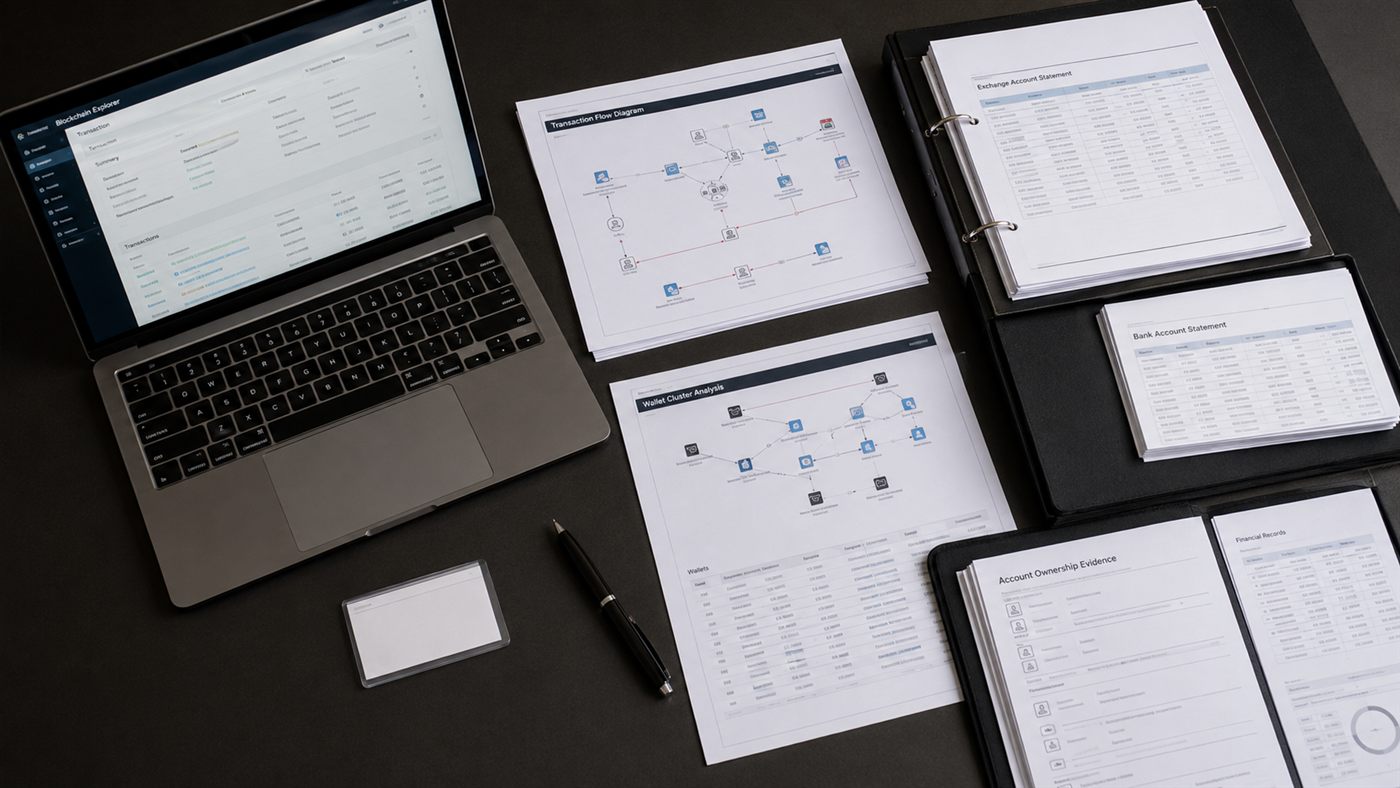
First identify the asset itself. Token name, network, exact quantity, wallet address, transaction identifier, and movement history matter. Next, link the digital asset to a specific person. That link may be supported by exchange KYC data, account UID, email, phone number, bank transfers to the platform, withdrawals to a known account, or an electronic declaration.
After that, examine the source of acquisition. A bank statement, P2P order, receipt, gift agreement, inheritance documents, or proof of premarital savings may matter more than the date tokens first appeared in a wallet. If the asset was sold, information about price, the recipient of the proceeds, and their further use is required. Only the combination of these data gives the court a coherent picture.
An evidentiary position is built on asset identification, a link to a person, and the source of funds
The Supreme Court ruling in case No. 337/4714/20 is instructive. The claimant asserted that the spouses had one bitcoin, which the husband sold, and that the proceeds were used to buy an apartment. In support she relied, among other things, on a receipt for transfer of logins and passwords to all joint accounts, and on testimony from a witness who knew about the cryptocurrency from others. Those proofs were insufficient to establish that the spouses had acquired the bitcoin and that its sale was linked to the apartment purchase.
That case does not establish a universal list of documents without which a claim is impossible. It gives a different, more practical guide. Each link in the evidentiary chain must support the next. General words about joint accounts do not replace proof of a specific asset, and mentioning a cryptocurrency sale does not prove that particular funds were used to acquire other property.
How to search for hidden crypto assets lawfully
There is no single register where you can enter a surname and see all of a person’s crypto wallets. A public blockchain shows movement between addresses but usually does not name their owners. The search therefore starts from known personal data: bank payments, exchange emails, declarations, UIDs, known addresses, or documents naming a specific platform.
If information cannot be obtained independently, a party may ask the court to compel disclosure under Article 84 of the Civil Procedure Code of Ukraine. Article 93 of the Civil Procedure Code allows written questions to the other party about circumstances relevant to the case. In some situations, securing evidence or securing the claim should be considered. A motion must be specific. The court needs to understand which platform holds the data, which account or asset is identified, what exactly must be obtained or restricted, and why there is a risk of losing evidence or alienating property.
Blockchain analytics helps reconstruct fund movement, but address ownership must be proven separately
Practical chances are best when cryptocurrency is held on a centralised exchange. There is an operator that identifies the client and can restrict account operations. If the asset is in a non-custodial wallet, the situation is harder. A blockchain entry cannot be frozen by an order of a Ukrainian court, and a transfer without the private key is technically impossible.
Foreign exchanges remain a separate problem. A Ukrainian judgment does not guarantee that a platform in another jurisdiction will provide information or freeze an asset. Sometimes international legal assistance is needed; sometimes enforcement will be disproportionately difficult. That should be assessed before filing a claim, not after obtaining a judgment.
Logging into someone else’s account yourself, or using a found password or seed phrase, is not an acceptable way to gather evidence. It creates separate legal risks and may cast doubt on the admissibility of the information obtained. What matters for a court case is not any access, but lawfully obtained and recorded evidence. See also: what to do if an exchange account is blocked; USDT AML screening.
Which division methods are realistic
The simplest path is agreement. If the parties agree to transfer cryptocurrency, the document should state the exact quantity, asset name, network, recipient address, transfer deadline, fee allocation, and method of confirming performance. That confirmation is usually a transaction identifier. Handing over a seed phrase instead of a defined share of an asset is unsafe, because it opens control of the entire wallet.
In litigation, division of fungible tokens in kind is theoretically possible. A claim for transfer of part of the cryptocurrency makes sense only when the asset, quantity, network, and person able to execute the transfer are established. There is not yet enough stable Ukrainian practice in which a court not only determined shares but also secured actual token transfer between former spouses. It is therefore early to speak of an established mechanism.
Monetary compensation is often more realistic. Subject to the conditions of Article 71 of the Family Code, the asset may remain with the spouse who controls it, while the other is awarded the value of the appropriate share. If the cryptocurrency was sold, the proceeds may be the subject of division. If a joint asset was covertly alienated not in the family’s interests, counsel may raise accounting for its value in the division. Such a claim is not automatic. One must prove the asset’s existence, its joint regime, the alienation, value, and the circumstances of disposal.
How to determine the value of cryptocurrency
For a volatile asset, the compensation amount depends not only on the number of tokens, but also on the chosen valuation date and price source. In property-division disputes courts proceed from the actual value of property when the case is considered. For cryptocurrency that rule requires a more precise methodology, because price can change substantially even within one day.
A calculation should record date and time, trading pair, venue, liquidity, and fees. If the parties cite different exchanges, explain why a particular source was chosen, or use data from several liquid platforms. The National Bank of Ukraine does not set an official rate for BTC, ETH, or USDT. The NBU rate may be used to convert a dollar value into hryvnia, but it does not confirm the token’s own price.
For compensation, valuation date, price source, and venue liquidity are critical
A stablecoin should also not be mechanically equated one-for-one with the dollar. Its market value can deviate from the stated peg. If valuation or technical identification of the asset is contested, an opinion from a specialist or expert may be needed. At the same time, there is no single mandatory methodology for valuing crypto assets in family disputes today. That is a real gap, not a theoretical one.
What Ukrainian law has not yet resolved
The most visible problem is not whether cryptocurrency can be recognised as property. General norms already suffice for that. Difficulty arises at ownership identification, valuation, and enforcement. The state has no register linking a non-custodial wallet address to a natural person. There is no unified procedure for freezing a digital asset in a civil case. Cooperation with foreign platforms depends on their jurisdiction and internal rules.
There is even less certainty about DeFi positions, liquidity-pool tokens, staking rewards, forks, airdrops, and NFTs. For each such asset one must separately establish what belongs to the person, when the property right arose, from which primary asset it was obtained, and whether it can be transferred without losing its substance. Stable family-law case law giving universal answers does not yet exist.
It would therefore be wrong in this article to promise that any wallet can be found, any token frozen, or any exchange forced to comply with a Ukrainian judgment. Such possibilities depend on the evidence, how the asset is held, and the specific platform. An honest legal position starts by recognising those limits.
How we build such a case at ProDefence
Work on a crypto-asset division dispute starts with inventory, not with a statement of claim. We separate confirmed facts from assumptions, identify possible platforms and addresses, match transactions to bank operations, and determine the source of funds. After that it becomes clear whether there are grounds to speak of joint property and what evidence still needs to be obtained.
The next step is choosing a claim that can be enforced. Sometimes that is transfer of part of the asset. In another case compensation or division of proceeds is more sensible. If there is a risk of rapid token withdrawal, procedural measures are prepared together with proof of account ownership. A formal request to freeze all of the respondent’s cryptocurrency without naming a platform, identifier, and technical feasibility is unlikely to create real protection.
For the client what matters is not only winning the dispute, but a result that can be obtained after it. Enforceability should therefore be assessed at the outset. In disputes involving digital assets that is not a final technical stage, but part of legal strategy. If an asset has already been withdrawn or compromised — see also the step-by-step guide after cryptocurrency theft.
Key takeaway
Cryptocurrency can be included in marital property division. The outcome depends not on the asset’s name, but on a proven link between the token, a specific person, the period of marriage, and the source of funds. The earlier the digital and financial trail is preserved, the less room remains for speculation.
Legal analytics
Need help dividing crypto assets?
In cryptocurrency disputes it is not enough to assert that a digital asset exists. You must timely record it, link addresses and exchange accounts to a specific person, establish the source of funds, and choose a remedy that can actually be enforced.
The ProDefence team combines legal representation with professional blockchain analytics. We help assess case prospects, investigate crypto-asset movement, build an evidentiary base, prepare necessary procedural motions, and define a practical strategy for dividing the asset or awarding compensation.
If cryptocurrency is being hidden, moved to other addresses, or denied as joint property — contact ProDefence. The earlier legal and technical work begins, the more opportunities there are to preserve the digital trail and use it to protect your interests.